The fire resistance analysis of individual unprotected elements of steel structures is implemented in Kristall. The check is performed by the critical temperature method according to DSTU-N B B.2.6-211:2016 (the recommendations of this standard are similar to EN 1993-1-2:2005). The method assumes that when the structure is heated by a fire, the temperature of the steel is uniformly distributed throughout the structure and its critical value is determined by the reserve of strength of the considered element. This reserve of strength is characterized by the load-bearing capacity utilization factor μ0, the physical meaning of which corresponds to the coefficient Kmax. Taking into account μ0 the critical temperature is calculated by the following formula:
\[ \theta_{a,cr} =30,19\ln \left( {\frac{1}{0,967\mu_{0}^{3,833} }-1} \right)+482. \]
The program determines the value of the load-bearing capacity utilization factor Kmax from the combination of loads which includes only the values of constant and long-term loads at t = 0, using characteristic values of the material strength properties (see, for example СП 296.1325800.2017).
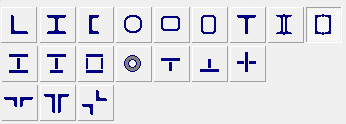
The fire resistance analysis is implemented in the following modes: Resistance of Sections, Columns, Beams, Continuous Beams, Truss Member for the following types of sections:
Characteristic values of the permanent and long-term loads are taken into account only.
The factor for safety factor for loadings and factor for sustained load has to be specified for each load case when specifying the initial data in the Columns, Beams, Continuous Beams modes. The safety factor for loadings and factor for sustained load or characteristic long-term values of internal forces can be specified in the Resistance of Sections and Truss Member modes.
The critical temperature, time to reach this temperature, and the air and steel temperature-time curves are obtained in the result of the analysis. Moreover, the software outputs the reduced thickness (the ratio of the cross-sectional area to the heated perimeter) and the proper fire resistance limit without fire protection (the time it takes to reach the temperature of 500°C in a standard fire, which causes significant change in strength and deformability — see Table 6 of the Manual for determining the limits of fire resistance of building structures, fire hazard parameters of materials. Procedure for the design of fire protection. M. 2013 or Annex B STO APCC 11251254.001-018-03).
The results are output in the Fire Resistance tab.
The analysis is performed for one of the following types of the structural heating (Fig. 2):
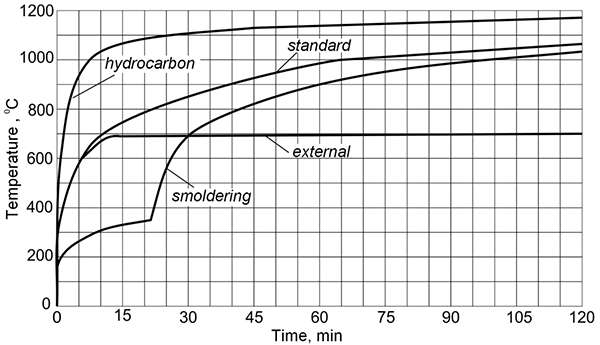
Figure 1. Temperature-time curves
The type of fire is selected from the respective drop-down list in the Fire Resistance tab. The analysis can be performed for the following types of fire exposure:
The temperature increase of steel at heating is calculated taking into account the change in the thermal conductivity and the specific heat of steel (Fig. 2).
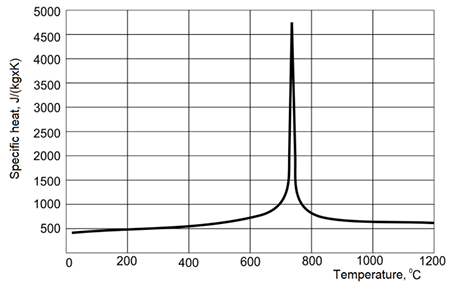
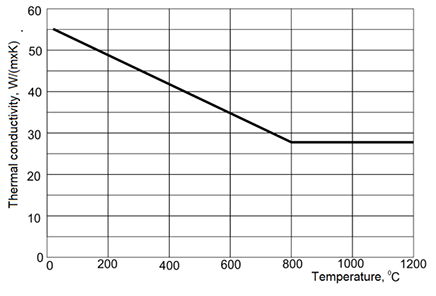
Figure 2. Variation of the thermal properties of steel